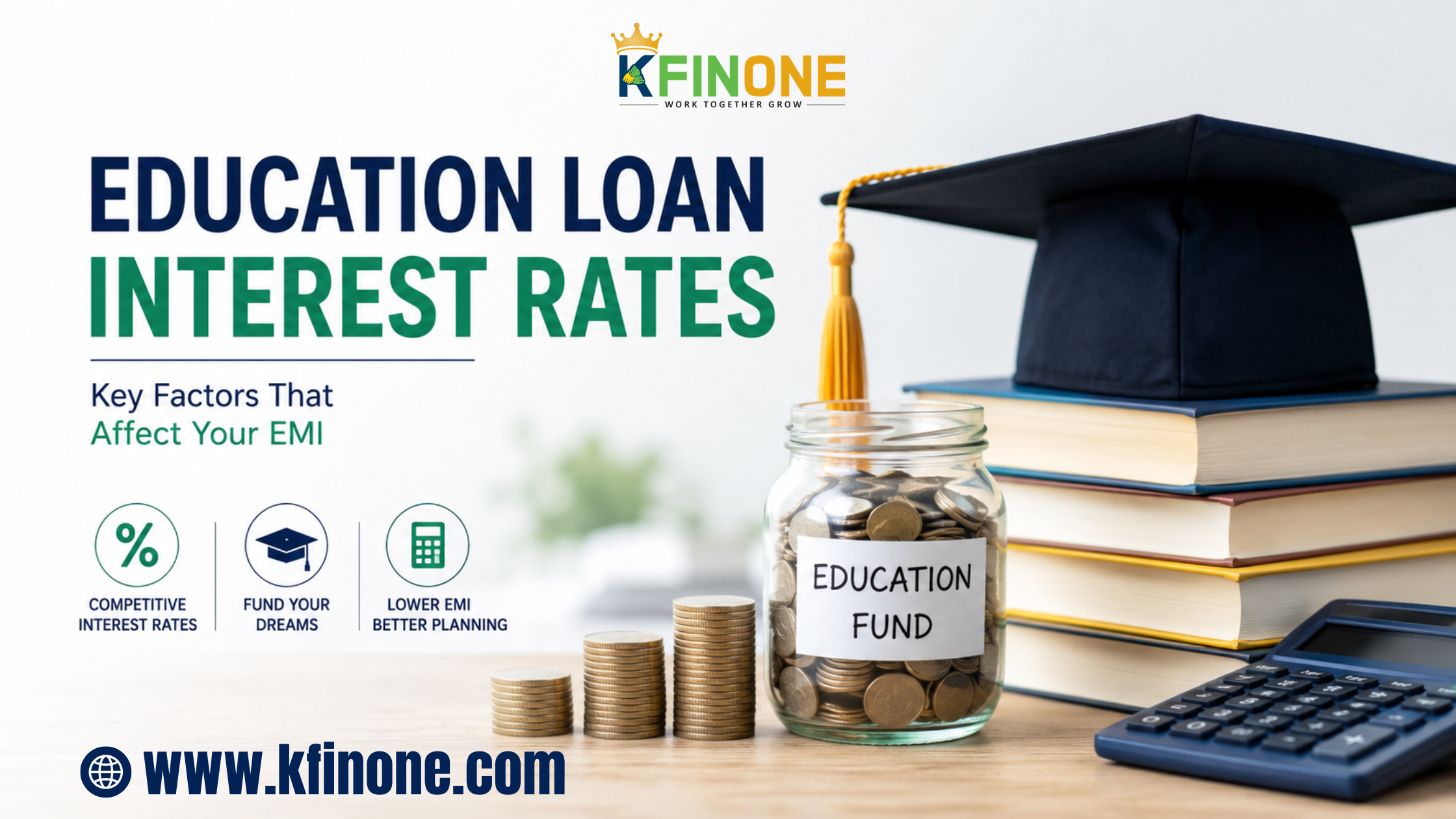
Education Loan Interest Rates: Key Factors That Influence Your Monthly EMI
Pursuing higher education is a valuable investment in your future, but the cost of tuition, accommodation, books, and other academic expenses can be significant. An education loan helps students manage these expenses without putting immediate financial pressure on their families. Before applying for a loan, it is important to understand how interest rates work because they directly affect your monthly EMI (Equated Monthly Installment) and the overall repayment amount.
Understanding the factors that affect education loan interest rates can help you select a suitable loan and manage your repayment more efficiently over time.
Understanding Education Loan Interest Rates
An education loan interest rate is the cost charged by a lender for providing financial assistance to students. It is calculated as a percentage of the loan amount and determines how much you will repay over the loan tenure.
The interest rate offered by a lender is based on several factors, including the applicant's financial profile, loan amount, repayment period, and the type of course or institution.
Why Interest Rates Matter
The interest rate has a major impact on your education loan repayment. Even a slight difference in the rate can increase or decrease your monthly EMI and the total interest payable throughout the loan tenure.
A lower interest rate helps you:
- Reduce your monthly EMI.
- Save money on total repayment.
- Manage your finances more effectively.
- Minimize your financial burden after graduation.
Factors That Determine Your Education Loan Interest Rate
1. Financial Profile of the Co-Applicant
Most lenders require a parent, guardian, or spouse to apply as a co-borrower. Since students generally do not have a credit history or regular income, the lender evaluates the co-applicant's financial stability.
A co-applicant with a strong credit score, stable income, and good repayment history is more likely to receive a competitive interest rate.
2. Reputation of the Educational Institution
The college or university you choose can influence your loan terms. Students admitted to well-recognized institutions often receive better financing options because these institutions usually have higher placement rates and better career opportunities.
Top universities in India and abroad are generally considered lower-risk by lenders.
3. Course You Are Pursuing
The nature of your academic program also plays an important role.
Courses that offer strong employment opportunities often receive favorable loan terms, such as:
- Engineering
- Medical Studies
- MBA
- Law
- Information Technology
- Data Science
- Management Programs
Professional courses with high earning potential are viewed positively by financial institutions.
4. Total Loan Amount
The amount you borrow influences the lender's risk assessment.
Higher loan amounts may require additional verification or collateral, while smaller loan amounts often have simpler approval processes. The interest rate may vary depending on the loan size and repayment capacity.
5. Secured or Unsecured Loan
Education loans are available in two forms:
Secured Education Loan
A secured loan requires collateral such as property, fixed deposits, or other approved assets. Since the lender has additional security, these loans often come with comparatively lower interest rates.
Unsecured Education Loan
An unsecured loan does not require collateral but may carry a slightly higher interest rate because the lender assumes greater financial risk.
6. Loan Repayment Period
The repayment tenure significantly affects your EMI.
A shorter repayment period usually results in:
- Higher monthly EMI
- Lower overall interest cost
A longer repayment period generally offers:
- Lower monthly EMI
- Higher total interest payment
Selecting a repayment tenure that matches your future income expectations is essential.
7. Existing Relationship with the Lender
If you have an existing relationship with the lender through a savings account, salary account, or previous loan and a consistent repayment history, you may be eligible for more favorable loan terms.
Existing customers often enjoy quicker processing and better interest rate offers.
8. Economic and Banking Conditions
Education loan interest rates are also affected by external financial factors, including:
- Reserve Bank of India (RBI) policy decisions
- Inflation levels
- Banking regulations
- Market lending conditions
These factors may cause interest rates to increase or decrease over time.
Fixed Interest Rate vs Floating Interest Rate
Before accepting an education loan, understand the type of interest rate being offered.
Fixed Interest Rate
- Remains unchanged throughout the loan period.
- Monthly EMI stays consistent.
- Makes budgeting easier.
Floating Interest Rate
- Changes according to market interest rates.
- EMI or repayment tenure may vary.
- May benefit borrowers if interest rates decline in the future.
Choosing the right option depends on your financial planning and risk preference.
Ways to Secure a Better Interest Rate
You can improve your chances of obtaining an affordable education loan by following these tips:
- Maintain a good credit score for the co-applicant.
- Apply to reputed educational institutions.
- Compare loan offers from different lenders.
- Borrow only the amount required.
- Submit accurate and complete documentation.
- Consider collateral if appropriate.
- Apply with a financially stable co-borrower.
Additional Charges to Consider
While comparing education loans, do not focus only on the interest rate. Also check for:
- Processing fees
- Documentation charges
- Insurance costs (if applicable)
- Prepayment conditions
- Foreclosure charges
- Late payment penalties
Reviewing these costs gives you a clear picture of the overall borrowing expense.
Smart Tips for Managing Your Education Loan EMI
Managing your loan responsibly can make repayment easier after graduation.
Some practical suggestions include:
- Create a monthly budget before repayment begins.
- Pay interest during the moratorium period whenever possible.
- Avoid missing EMI payments.
- Increase EMI when your income grows.
- Make part-prepayments whenever extra funds are available.
- Keep track of your repayment schedule.
These habits can reduce your total interest burden and help you close the loan sooner.
Why Choose KFINONE for Your Education Loan?
KFINONE helps students access education loan solutions designed to support their academic aspirations. Whether you plan to study in India or overseas, KFINONE offers assistance throughout the loan application process.
Key advantages include:
- Competitive education loan options
- Simple eligibility assessment
- Quick documentation support
- Flexible repayment plans
- Dedicated customer assistance
- Smooth and transparent loan process
With the right financial guidance, students can concentrate on their education while planning a secure financial future.
Conclusion
Education loan interest rates are one of the most important aspects to consider before financing your higher education. Factors such as the co-applicant's credit profile, institution, course, loan amount, collateral, repayment tenure, and market conditions all contribute to the interest rate offered by lenders.
By understanding these factors and comparing different loan options, you can choose an education loan that fits your financial goals and offers manageable EMIs. Careful planning today can help you complete your education confidently while keeping your future repayment obligations under control.